01 Feb From the Finish Line to the Clinic: What the Road to the Olympics Teaches Us About Health
With the 2026 Olympics around the corner, conversations about elite performance are everywhere – training regimens, mental grit, recovery protocols, and what it really takes to perform at the highest level on the world stage. But long after the medals are awarded, and the Olympic torch is extinguished, the lessons of high-level sport don’t fade. In fact, for some athletes, they slowly evolve into something far more lasting.
For Dr. Rachelle Viinberg, ND, three-time Olympic rower and naturopathic doctor, the path to the Games and the path into medicine were never separate – they ran parallel, shaping and strengthening each other in ways she couldn’t have predicted.
Her athletic journey, surprisingly, didn’t begin in a boat. It started in the pool, where she was once ranked number one in Canada for her age group and had a single, unwavering dream: the Olympics. “That was my number one dream,” she says. Puberty, weight changes, and what she later discovered to be undiagnosed thyroid disease changed that trajectory. Forcing her to face a truth that many athletes – and patients – face: sometimes the goal stays the same, but the path has to change. “So, swimming didn’t work out, but I find there’s always a way. It may not look the way you want it to, but you have to reshift your goals to where the situation is.”
Rowing arrived almost by accident. Inspired by watching Canadian rowers dominate the 1996 Olympics – Kathleen Heddle, Marnie McBean, medals flashing across the screen – and encouraged by parents who insisted she stay active after leaving swimming, she discovered a sport that rewarded her height and resilience. “Seeing some of these people do so well…that’s really how I got into it, watching the Olympics,” she recalls. What followed were years of relentless training – up to 18 sessions a week – along with university studies and national team commitments.
But while her body was working at an elite level, her recovery wasn’t. As a vegetarian teenager surviving on bagels and microwave popcorn, she was constantly sick, exhausted, and not fueled. “I was 19, I felt like garbage all the time,” she says. “I was always getting sick.” A visit with a naturopathic doctor changed all of that. The advice was simple – protein, better recovery, basic nutrition – but it was a revelation. “Right now, you think it’s common sense,” she says, “but I didn’t know. That planted the seed.”
By the time she started at the Canadian College of Naturopathic Medicine, she wasn’t just training to win – she was also learning how bodies heal.
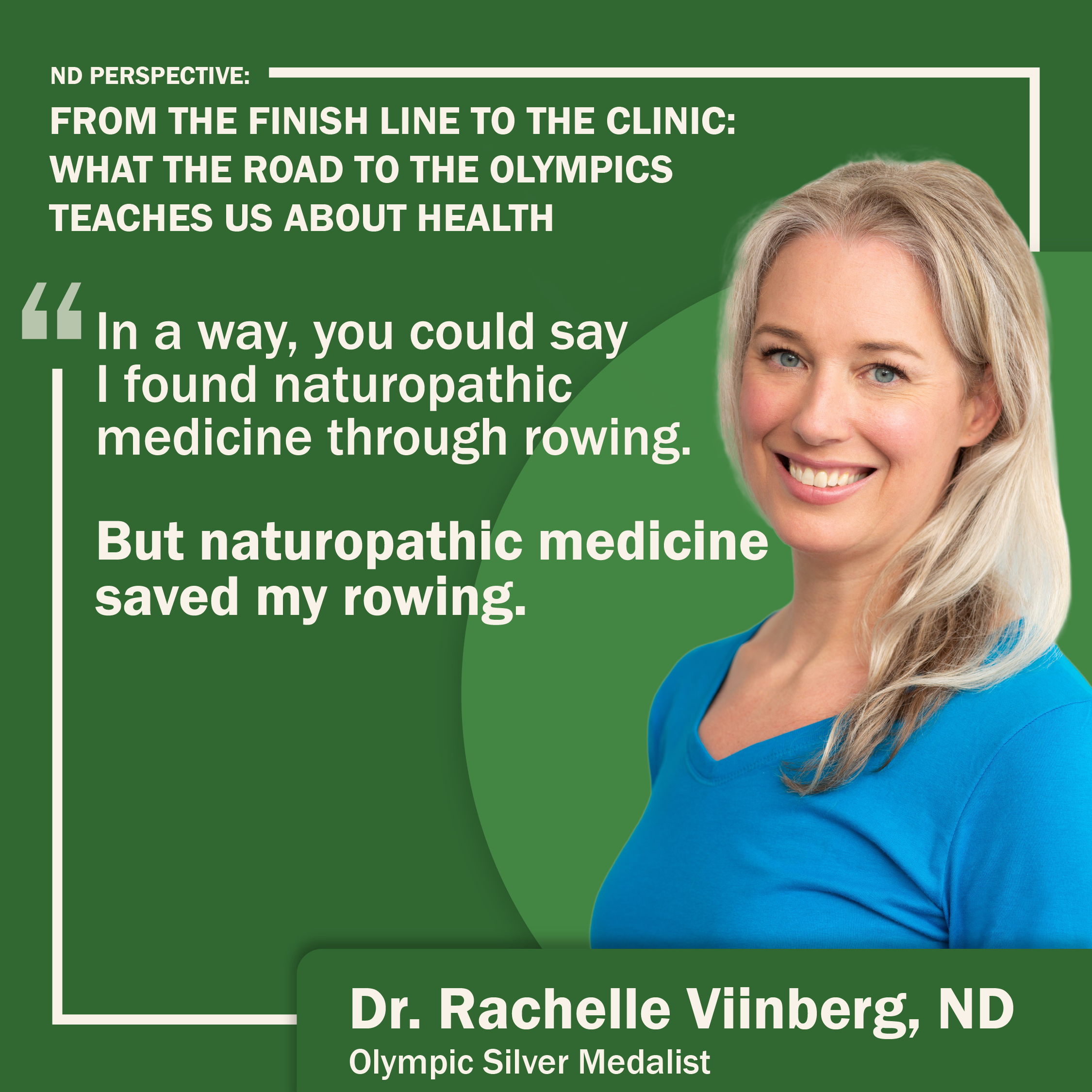
That knowledge became critical when, just three months before an Olympic Games, she suffered a herniated disc – the same injury that had once sidelined her for an entire year. “I thought my chances of coming back were pretty slim,” she admits. But this time was different. She had graduated from CCNM and used that knowledge to work her way back onto the water. Armed with tools like acupuncture, curcumin, anti-inflammatory nutrition, visualization, and a greater understanding of recovery, she returned to the boat in weeks, not months. “In a way, you could say I found naturopathic medicine through rowing,” she reflects, “but naturopathic medicine saved my rowing.”
Over three Olympic Games, each experience deepened her understanding of performance and pressure. The first Games came with injury and unfulfilled dreams. The second brought growth, but still fell short. The third resulted in a silver medal, and with it the kind of unforgettable experience only elite sport can deliver. The roar of 40,000 spectators. The final 250 metres, where “your body is just screaming to stop…you can’t even hear the coxswain.”
Then came retirement – perhaps the hardest transition of all.
For two decades, her life had been dictated by schedules, coaches, and training plans. “Every hour is laid out,” she explains. “I wasn’t used to that freedom…you have to start all over again.” Learning how to detrain – slowly and intentionally – reshaped both how she moved and what she thought about health. “Now, I definitely train for longevity and being able to get out of a chair when I’m 80,” she says. “Before, it was for an Olympic medal.”
She now brings that new mindset, along with an athlete’s discipline, patience, and focus on recovery, to her practice, coupled with a deep appreciation for individuality. “There’s no blanket advice to give,” she says. Bloodwork, lifestyle, and mindset all matter. Progress is built through small, tangible goals, consistency over time, and a willingness to be uncomfortable enough to grow. “People want the results really quick,” she observes. “Life doesn’t work that way. It takes consistency and time, and persistence.”
It’s a philosophy shaped by years of doing things she didn’t want to do – early mornings, brutal training sessions, commuting between Olympic training and naturopathic medical school, even squeezing in rowing sessions in a literal broom closet between classes at CCNM. “To get any kind of growth, you’ve got to be uncomfortable,” she says. “Sometimes the things you hate the most, you start to love.”
As we all await the 2026 Olympics, her focus has shifted to achieving different goals -just as impactful – like access, education, and long-term health. Through teaching, sports medicine, and individualized care, she works with everyone from elite athletes to women navigating hormonal changes and those focused on healthy aging. “I love what I do,” she says, “I’ll never retire.”
So, while the medals might sit in the past, the lessons are alive and well, reminding us that health, like sport, is rarely about quick wins. It’s about showing up consistently, adapting when things don’t go to plan, learning when to push, and when to recover.
And that might be the most Olympic lesson of all.
Dr. Rachelle Viinberg is a naturopathic doctor, three-time Olympic rower, and silver medalist, with a background in biology and elite sport. As a former member of the Canadian National Rowing Team, she brings firsthand experience of high-performance training, injury recovery, and long-term resilience into her clinical work. Dr. Viinberg, ND, is a sports medicine instructor at the Canadian College of Naturopathic Medicine, and her work bridges the gap between elite performance and sustainable, lifelong health.