18 Mar Endometriosis Awareness Month – Listening to Women’s Pain
For Endometriosis Awareness Month, the CAND is taking a closer, more compassionate look at a condition that affects at least 1 in 10 girls and women – and, according to Endo Network Canada, unmeasured numbers of two-spirit, transgender, and gender-diverse individuals – nearly 2 million Canadians in total. For something so common, the road to diagnosis is often long, and 8 in 10 people say they were told their pain was “normal” before finally getting answers. Some estimates suggest up to 60% of cases remain undiagnosed. In this conversation, Dr. Briana Lutz, ND, speaks to what it means to truly listen and how individualized naturopathic care can support patients, especially after years of searching for answers.
One of the biggest challenges is diagnosis. “The gold standard to diagnose endometriosis is laparoscopic surgery – essentially exploratory surgery,” Dr. Lutz, ND, explains. “For somebody to get access to that is a huge barrier.” Because surgery is often required to confirm the condition, many patients spend years seeking explanations for symptoms that are sometimes dismissed by healthcare providers.
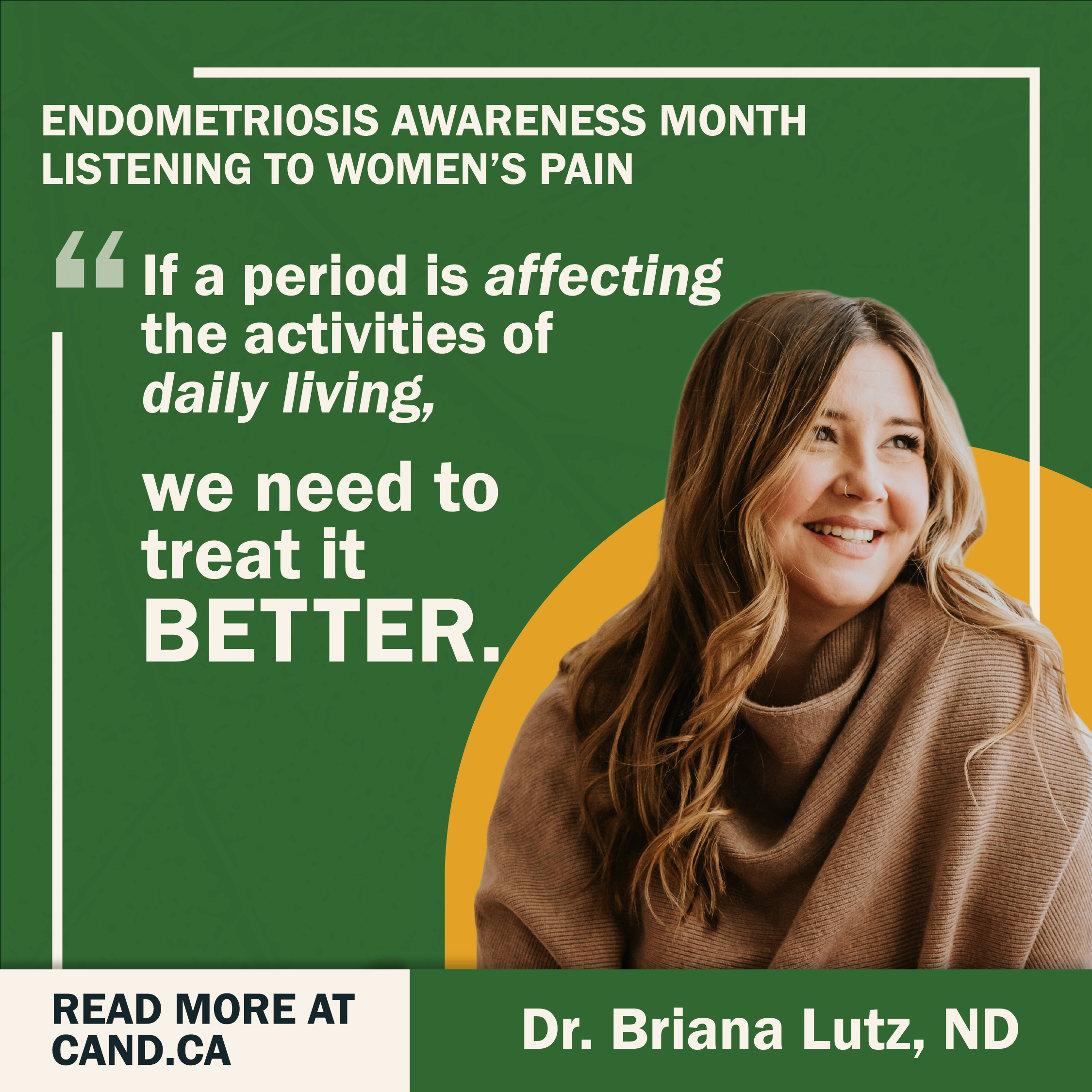
“It’s a disservice when medical professionals say, ‘It’s just a bad period,’” she says. “Period pain is common, but it’s really not normal. If a period is affecting the activities of daily living, if you are passing out or vomiting from the pain, that is not normal, and we need to treat it better.”
The severity of pain does not necessarily match the stage of the disease. Someone with early-stage endometriosis may experience debilitating pain, while another person with an advanced disease may have comparatively mild symptoms. “Staging doesn’t equate to the level of pain or how it affects somebody’s daily life,” Dr. Lutz, ND, notes.
Endometriosis can also present with a wide range of symptoms beyond menstrual pain. Digestive issues, bloating, migraines, bladder discomfort, or pain during intercourse can all be related. Many patients are initially told they have other conditions. “Probably the most common thing is people being diagnosed with IBS (irritable bowel syndrome),” she says. “But, once they learn about endometriosis and endo belly, they realize that totally describes what they are experiencing.”
Because diagnostic tools are limited, Dr. Lutz, ND, emphasizes the importance of a detailed clinical assessment. Understanding a patient’s history, symptoms, previous testing, and treatment experiences can help guide care – even when a formal diagnosis has not yet been confirmed.
Ruling out other conditions can also help determine treatment. A pelvic ultrasound, for example, may identify conditions such as adenomyosis. Blood tests can also offer clues. Dr. Lutz, ND, may look at inflammatory markers or a test called CA-125.
We now know the role that family history, like having a first-degree relative with the condition, can play in a diagnosis. Though that information isn’t always easy to trace, as many cases in previous generations went unrecognized. In the past, conversations about menstruation and reproductive health were often avoided altogether, “so the conversations we’re having right now are really important,” stresses Dr. Lutz, ND.
However, no matter where someone is in the diagnosis phase, “I always tell my patients, we’re treating it as if it’s endometriosis until proven otherwise,” she says. “We can start on treatment right away.”
Her strategic approach to care often starts with one of the most urgent concerns – pain reduction. “By the next time I see you, I want your pain to be 50 to 70% better.” Once symptoms are managed, she gradually addresses other comorbidities and the long-term implications of endometriosis, including cardiovascular risks. “It’s about being proactive and preventative in care, not just treating the symptoms,” she explains.
Because endometriosis is a chronic condition that can affect many aspects of life – including fertility, mental health, and long-term health risks – Dr. Lutz, ND, emphasizes collaborative care. She frequently works alongside gynecologists, fertility specialists, pelvic floor physiotherapists, and mental health professionals to support patients fully. She believes they should understand all of their options – conventional and naturopathic – so they can make informed decisions. And patients don’t have to choose one; they can do both.
The options that naturopathic medicine offers can be particularly helpful because endometriosis is a systemic condition, not just a localized pelvic issue. Endometrial-like tissue can grow on structures such as the ovaries, uterus, fallopian tubes, bowel, or bladder, and its effects can extend beyond those areas; lesions have been identified in the central nervous system, with studies available in the National Library of Medicine. Because of this, Dr. Lutz, ND, says treatment must consider the broader immune system, not just the location of the lesions.
While conventional medicine often focuses on hormonal suppression to reduce symptoms, Dr. Lutz, ND, views endometriosis as more complex. “Endometriosis is an immune, inflammatory condition that is aggravated by hormonal fluctuations,” she explains. Addressing inflammation, immune function, and related symptoms is an important part of comprehensive care.
“We’re really targeting the immune system and inflammation,” she says, using compounds such as PEA (palmitoylethanolamide) to help regulate immune responses and reduce pain. Nutrients like vitamin D – often low in people with chronic pelvic conditions – can be used to help support immune balance, and other options like N-acetylcysteine (NAC) may also reduce inflammation.
When surgery is part of treatment, Dr. Lutz, ND, notes that specialists often recommend combining it with hormonal therapy because there is a high remission rate. Without additional treatment, endometrial tissue can regrow and lead to further procedures.
Decisions about surgery depend on several factors, including the stage of the condition, how significantly it affects daily life, and a person’s future fertility goals. Access to a health professional with surgical expertise in endometriosis surgery can also be a challenge, she adds.
If fertility plays a role in treatment decisions, Dr. Lutz, ND, acknowledges that many conventional, first-line treatments focus on pain relief and hormonal suppression, which can make conception more difficult. This can create tough choices for people trying to conceive while managing symptoms. In those cases, she says naturopathic care is ideal and can offer supportive options that address inflammation and symptoms, without suppressing fertility.
Just as important as treatment is validation. Many patients have spent years feeling unheard. For many, the most important thing they heard in that first visit was ‘I believe you and your pain is real,’ Dr. Lutz, ND, says. “We’re seeing delays of eight years sometimes before diagnosis. That validation is really important.”
Ultimately, she wants people experiencing symptoms to know they deserve support and options. “Your symptoms are real, and your pain is real,” she says. “And if something didn’t work, there’s always another option for you.”
As awareness grows and conversations continue, advocates and clinicians alike hope that earlier recognition, better research, and more comprehensive care will shorten the path to diagnosis and ensure that people living with endometriosis are finally heard.
Dr. Briana Lutz is a licensed naturopathic doctor dedicated to providing thoughtful, informed care with a strong focus on women’s health and complex chronic conditions. She has a particular passion for supporting patients navigating endometriosis, hormonal imbalances, digestive concerns, and symptoms that have gone unanswered for years. Dr. Lutz takes a collaborative, individualized approach, blending clinical investigation, functional testing, and customized treatment plans to address root causes while improving day-to-day quality of life. Known for her compassionate listening, she works closely with patients to help them feel heard, empowered, and supported at every stage of their health journey.