
22 Apr Reclaiming Energy After Cancer: Why Fatigue Deserves More Attention
Cancer care is evolving, and Dr. Jessa Landmann, ND, is helping lead a more patient-centred approach – one that looks beyond treatment to how people actually feel during and after cancer. In an interview with the CAND, she explored what integrative cancer care looks like in practice, why cancer-related fatigue remains widely misunderstood and under-treated, and how her clinical experience inspired her recently released book, Beyond Cancer Fatigue: A Path to Reclaiming Energy. She also reflects on the gaps in survivorship care and invites patients, caregivers, and clinicians to rethink recovery, support, and quality of life long after treatment ends.
For many people, the end of cancer treatment is supposed to feel like relief. Chemotherapy finishes. Radiation ends. Appointments become less frequent. Friends, family, and workplaces expect life to return to normal. Yet, for a significant number of cancer survivors, this is when a different struggle begins – one that is rarely discussed, often misunderstood, and deeply disruptive.
Cancer-related fatigue is one of the most common challenges people face after treatment, with some estimates suggesting that up to 90 percent of survivors continue to struggle with fatigue, sometimes for years. This is not ordinary tiredness that gets better with rest. It is a persistent, whole-body exhaustion that affects cognition, mood, sleep, physical strength, and the ability to fully participate in daily life. Despite how common it is, fatigue is frequently minimized, dismissed, or framed as something people simply need to be patient with.
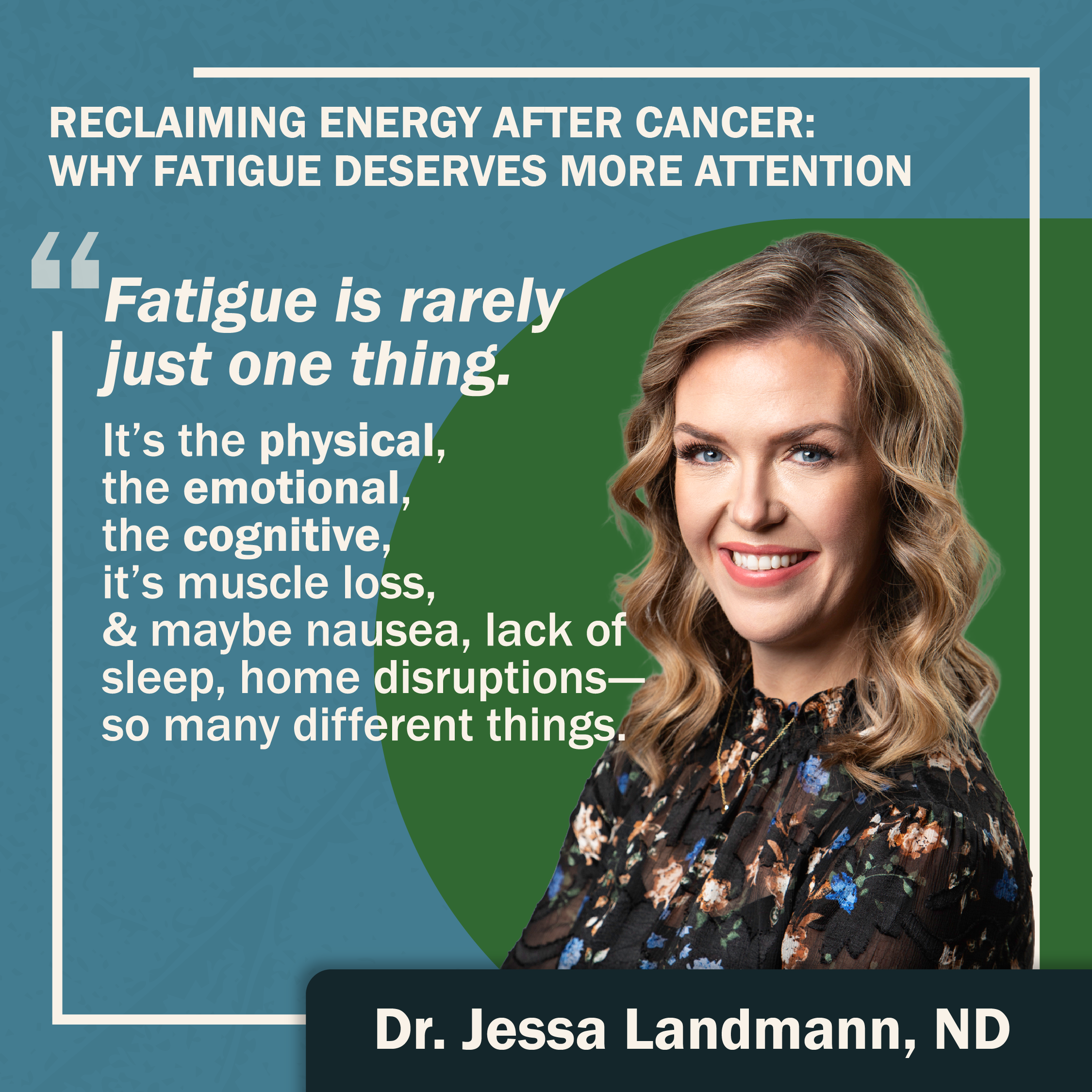 This gap between being “done” with treatment and feeling well is where naturopathic doctor Dr. Jessa Landmann has focused much of her clinical work – and what ultimately led her to write Beyond Cancer Fatigue: A Path to Reclaiming Energy. In her practice, fatigue is not treated as a single symptom, but as a complex experience with many overlapping drivers. “Fatigue is rarely just one thing,” she explains. “It’s the physical, the emotional, the cognitive, it’s muscle loss, and maybe nausea, lack of sleep, home disruptions, so many different things.”
Ideally, Dr. Landmann, ND, says, supportive care would begin as early as possible – even at the time of diagnosis. This early stage, often referred to as prehabilitation, can make a meaningful difference in how patients move through treatment. Addressing pain, sleep issues, nutrition, inflammation, and stress before chemotherapy or radiation begins can help prevent symptoms from worsening later on. But she acknowledges that this is rarely how things unfold. A new cancer diagnosis is filled with appointments, information, decisions, and fear. For many, there simply isn’t the capacity to think beyond immediate treatment.
As a result, patients often find her once treatment is already underway, when symptoms begin to pile up. While prescription medications play an important and necessary role, they don’t always provide full relief, and side effects can add another layer of burden. “What else can I do?” patients ask. That is often when integrative therapies such as acupuncture, targeted nutritional support, anti-inflammatory diets, movement, and carefully selected supplements become part of care – not as alternatives, but as support.
Many of Landmann’s patients come to her after treatment has ended, at a point when they are technically finished but feel anything but recovered. They are told they are “done”, yet their energy hasn’t returned, their bodies feel unfamiliar, and their confidence in their health is shaken. Survivorship, she notes, is one of the most under-supported phases of cancer care. Once the regular rhythm of oncology appointments falls away, people are often left to navigate lingering symptoms on their own, wondering if what they’re experiencing is normal and whether it will ever improve.
From a biological perspective, there are clear reasons fatigue can persist long after treatment ends, explains Dr. Landmann, ND. Chemotherapy and immunotherapy can create widespread inflammation throughout the body, including damage to mitochondria – the structures within cells responsible for producing energy. When mitochondrial function is impaired, energy production drops. Inflammation can also affect the brain, contributing to brain fog, mood changes, sleep disruption, and pain. Muscle loss, another commonly overlooked factor, plays a significant role as well. Muscle is a major site of mitochondria, and without intentional rebuilding, deconditioning can worsen fatigue. Insulin resistance, thyroid dysfunction, anemia, and chronic inflammation are also common contributors.
This complexity is why Dr. Landmann, ND, begins her assessments with comprehensive blood work to rule out anything fixable or measurable. But she is quick to point out that improved lab results don’t always translate into feeling better. Recovery often requires a layered approach: rebuilding muscle, supporting sleep, improving nutrition, addressing weight changes, and tending to mental and emotional health. The psychological impact of cancer – trauma from treatment, fear of recurrence, grief over lost health, and the pressure to “get back to normal” – can be just as exhausting as the physical effects. Mind-body therapies, counselling, mindfulness, and gentle movement are central parts of care, particularly for survivors.
Beyond Cancer Fatigue grew directly out of this clinical reality. Again and again, Dr. Landmann, ND, saw patients being told to wait, to be patient, to trust that time alone would heal them. Many felt invalidated and stuck. The book was written to offer something different: practical guidance, validation, and a framework for understanding fatigue as something that can be addressed, not endured. Each chapter focuses on a different contributor to fatigue, with specific, actionable tools. Nutrition and sleep, weight changes, hormone health, mental health, supplements, blood work, and complementary therapies are just some of the covered topics.
There are chapters that speak to menopause, anxiety, and other experiences where fatigue plays a central role. Still, survivorship remains the heart of the work – a phase she sees as one of the greatest unmet needs in oncology care. At its core, the book is about language and legitimacy. “For patients, my hope is that this book is going to give them a language for an experience that is often invisible and very isolating. I want them to feel this isn’t just something they have to push through, this is something that they can heal from.”
While the book is primarily written for cancer survivors struggling with fatigue, Landmann is optimistic that its reach may extend further. She hopes it deepens understanding for caregivers, who often want to help but don’t know how, and for healthcare providers, who she hopes will begin to approach survivorship with more curiosity and nuance. Finishing treatment should not mean being left to quietly struggle. Cancer survivors are living longer, fuller lives, often while juggling work, family, caregiving, and recovery all at once, and need ongoing support.
Fatigue may be invisible, but its impact is profound – and, as Dr. Landmann’s work makes clear, it deserves far more attention than it gets.
Dr. Jessa Landmann is a licensed naturopathic doctor with a clinical focus on integrative cancer care, supporting patients through treatment, recovery, and long-term vitality. Her work bridges evidence-informed natural medicine with compassionate care, focusing on the overlooked impacts of cancer-related fatigue. In March, she released her new book, Beyond Cancer Fatigue: A Path to Reclaiming Energy, which draws on both clinical insight and patient experience to offer practical, empowering strategies for restoring energy and quality of life during and after cancer care.