
18 Feb Beyond Bloodwork: Building Peak Performance from the Inside Out
Known for his work with NHL players, UFC fighters, and high-performance professionals, Dr. Callum Cowan, ND, has built a practice around understanding how the body performs under pressure. As the founder of Phenom HPM, he has a reputation for digging deeper than standard testing, providing clients with clear, actionable answers to where their bodies are struggling and how to move the dial. In this interview, Cowan talks about what drew him to high-performance care, the lessons he’s learned from years inside elite sport, and shares everyday habits that can help anyone feel stronger and more resilient.
What originally motivated you to combine naturopathic medicine with high-performance sports when you founded Phenom HPM? In what ways does your approach differ from other optimization programs?
I grew up playing sports at a high level and felt like I could make an impact optimizing performance with what I had learned and planned on learning as a naturopathic doctor.
I think our approach differs because it is very comprehensive, based on years of experience working with high performers, and is always evolving based on what is working. Quite a bit different from the conventional side – they’re looking at things in a very limited way. They’re doing conventional blood work and more screening-type things, whereas I’m thinking more from a performance side. We look at many different aspects – gut health, inflammation levels, nutrient deficiencies, hormone balance, food sensitivities, metabolic markers, genetics, etc. Working with so many high performers over the last 10-15 years, you get a feel for what’s important to monitor, what optimal ranges are based on a cohort of pro athletes. To be at your peak, you need to be in a different optimal range. Over time, we’ve pulled in pieces that are effective and made it our own blend. I’m looking at things, monitoring, adjusting, and realizing what’s working and what’s not.
You mention uncovering performance limitations that conventional medicine often misses. What are the most common issues affecting performance that you routinely discover? Is there a case that stands out where deeper testing significantly changed the outcome for someone?
There are many aspects that conventional medicine is not looking at. Gut health, inflammation levels, nutrient deficiencies, performance nutrition, hormone balance, food sensitivities, metabolic markers, genetics, etc.
For example, nutrient levels; you’re looking for deficiencies in key nutrients for peak energy, amino acid levels for focus and attention, vitamin D levels, magnesium levels for muscle recovery, hormone balance, and metabolic markers. Depending on the sport, different things become more or less important.
Yes, the one that stands out the most is an NHL player I was working with. He was a top player on the team, but noticed over the years he was having a harder time staying lean, building muscle, and was feeling more and more sore and tired. He showed high inflammatory levels, low amino acid levels due to increased need for protein, magnesium deficiency, and multiple food sensitivities, adding to his inflammation. After three months on a specific nutrition and supplement/lifestyle plan, he dropped from 13% to 8% body fat, gained four pounds of lean muscle, and had great energy and recovery. The best off-season he had in as long as he could recall.
You’ve worked with athletes in some of the most demanding sports, from the NHL to UFC to the Olympics. What have you learned about how the body performs under such pressure? How much of what you’ve learned can be applied to everyday people, with everyday stresses?
For UFC fighters, we did a lot of weight cuts, a huge part of the sport. You’ve got to be able to manipulate your weight down and still perform at your best. You can’t deplete yourself and expect to perform well. Certain things become more important: thyroid chain working well, inflammation down, and absorbing nutrients well. Depending on the objective, things vary by sport. If you don’t make the weight, you can’t compete – it’s such a demanding sport. I’ll do the prep work before training camp; they’ll do eight weeks of camp and compete. You don’t want to be tanking by the time you’re competing – you want to be getting better, feeling stronger and faster. The pressure and the stakes are so high.
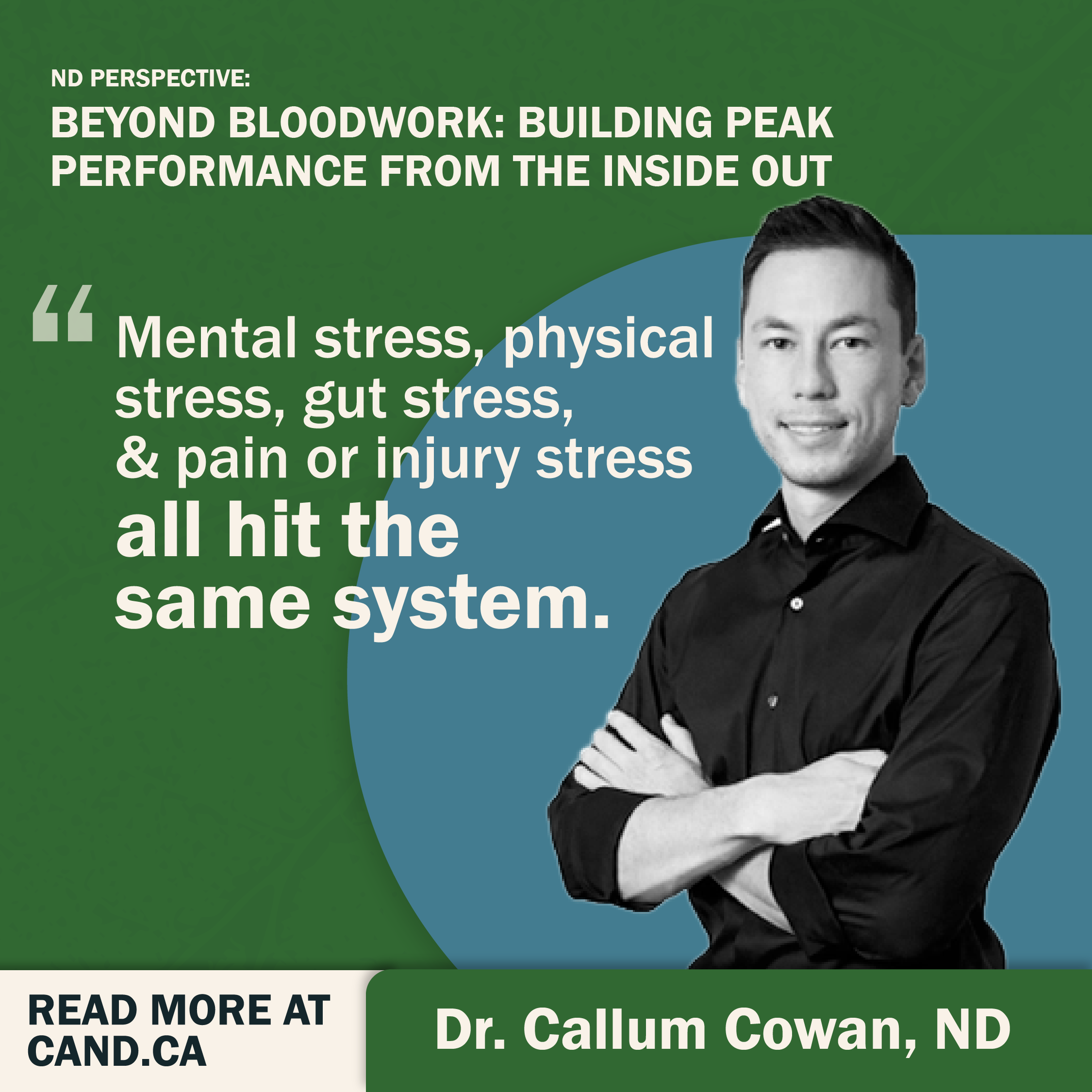
Stress has a big impact on the body. Mental/emotional stress, physical stress, gut stress, and pain/injury stress all hit the same system. The body is one integrated unit, not separate functioning components. If you are eating a highly processed diet, low fibre, high sugar, you create a lot of gut inflammation, which then impacts nutrient absorption, immune function, gut-brain, liver detox – the ripple effect.
I think everything can be applied [to anyone]. We are still looking at the same body systems. The main difference is the level of intensity – extra focus on supporting peak performance, building resilience, and maximizing recovery for the elite athletes.
You recently said, “The body doesn’t care whether the stressor is a Game 7 playoff or a Fortune 500 earnings call.” How does that philosophy influence the way you tailor your programs? What are the biomarkers that you see in both athletes and non-athletes?
High performers need a certain level of support to function with the demands on them. We scale that according to the intensity. Often overlooked is the mental strain aspect. You could be at a desk all day or in meetings, which can sometimes be more straining than the hard training of an athlete.
We work with a lot of high performers – people in business, real estate, firefighters, police officers, teachers – things break down in similar ways. Stress has a huge [impact]. In that, mental or physical [stress]. A big part of how people feel is their Circadian Rhythm. Our body likes rhythm. If you can start getting to bed at the same time, waking up at a similar time each day, you’ll function more effectively throughout the day.
We see a lot of protein deficiency – professionals not eating much, have a bunch of coffee, busy all day, maybe have some lunch, maybe have dinner, and then binge at night because now you’re really hungry. You’re not going to be able to make neurotransmitters like serotonin and dopamine that your brain needs for attention and mood. You want to aim for about .5 to 1 gram [of protein] per pound of body weight for the day.
Electrolyte intake. Even on hockey teams I work with, the London Knights in the OHL – they won the Memorial Cup last year – these guys have to learn about hydration and electrolyte intake. You can’t just drink water and expect to be hydrated. You need salt and electrolytes to pull water into the cell. If you’re sweating out salt, you need to replenish it. You could be sub-clinically dehydrated or underperforming just because you’re not getting any electrolytes in.
People working 9:00 to 5:00, caffeine intake is huge. I had a VP yesterday, who is always dehydrated in the afternoon, but he drinks so much coffee in the morning that he’s peeing out a lot of those electrolytes by 2:00 pm – 3:00 pm. He’s crashing in energy, feels dehydrated, and dizzy. We were able to trace it back to his intake in the morning.
For those who aren’t athletes but want to feel and perform better, what are a few things they can start doing that will make a noticeable difference? Are there any other habits you wish people would start – or stop – because they have a big impact on energy and performance?
The easiest, big impact things to start doing right away are: one, start going to bed and waking up at a similar time each day. Many of the key functions of the body are connected to your Circadian Rhythm. Two, start eating enough protein each day for muscle growth and repair, neurotransmitter production, appetite control, and blood sugar stability – so many important things. Three, electrolyte intake – you need some daily electrolytes, salt, to hydrate your cells and allow high function at the cellular level.
Avoid fried and really heavy foods. They can be desirable, but will make you feel sluggish, bloated, and foggy – the opposite of a high performer. Everything has to be based on an individual, but those are some things people can start with.
Dr. Callum Cowan, B.Sc., ND, is a Burlington-based naturopathic doctor whose career has focused on helping people understand their bodies with clarity and precision. A graduate of the Canadian College of Naturopathic Medicine (CCNM), where he completed a focus in sports medicine, he has spent years refining a data-driven approach to performance testing and optimization. His work with clients from high-performing professionals to elite athletes and more gives him a rare perspective on how stress, recovery, and resilience show up across different environments.